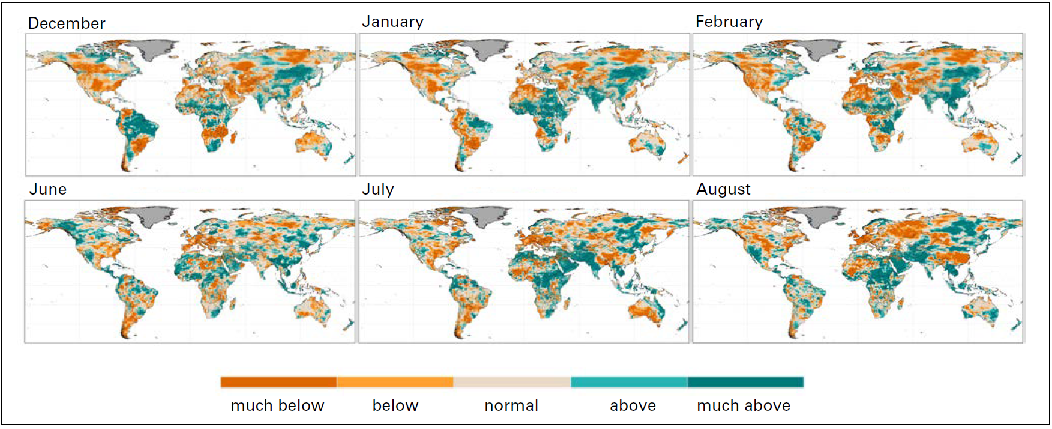
 Monthly anomaly in surface soil moisture in 2022 as ranked with respect to the historical period 2003 – 2020 (source: WMO State of Global Water Resources 2022).
The WMO State of Global Water Resources 2022 has been launched with significant improvements over the initial edition, including the addition of soil moisture to the analyzed hydrological cycle components. Within the report, soil moisture anomalies (topsoil, 5 cm) in 2022 are ranked relative to the historical period from 2003 to 2020 on a monthly basis to comprehend near-surface soil moisture patterns. In 2022, anomalies in soil moisture corresponded to variations in river discharge conditions. For example, Europe experienced increased evapotranspiration and decreased soil moisture during the summer, attributed to drought conditions.
“Unfortunately, in situ soil moisture observations could not be used for this edition of the report because they are still sparsely distributed in space and time. The International Soil Moisture Network (ISMN) had only 42 locations with data of decent quality, temporal coverage and length of observations in 2022 out of 240 stations that had data for this year. ISMN is working on increasing this number significantly for the next report.” – Matthias Zink, Team lead ISMN (culled from the report)
The report underscores the need to intensity the monitoring of hydrological variables and sharing of data to expand our understanding of the global water cycle, which is increasingly destabilized by climate change.
We are delighted with the contribution of ISMN to this significant report by offering expert advice and consultation.
To read the full report click here.
Monthly anomaly in surface soil moisture in 2022 as ranked with respect to the historical period 2003 – 2020 (source: WMO State of Global Water Resources 2022).